Key Takeaways
⌃- Introduction: AI Needs to Understand More Than Your Keywords
- What Is Entity SEO?
- What does this business represent?
- Why Entity SEO Matters More in AI Search
- What Information Makes Up a Business Entity?
- Entity Relationships Are More Important Than Isolated Keywords
- The Role of Structured Data and Schema
- How to Build a Strong Entity SEO Strategy
- Common Entity SEO Mistakes Businesses Should Avoid
- How SEO INDIA Can Help With Entity SEO
- Frequently Asked Questions About Entity SEO
- Final Takeaway
Introduction: AI Needs to Understand More Than Your Keywords
A few years ago, getting found online mostly meant one thing: rank on Google for the right keywords. Today, a customer might never see a traditional results page at all. They ask ChatGPT for a recommendation, get a summary from Google’s AI Overview, or let Perplexity compare options for them.
In each case, an AI system is making a judgment call. It reads what’s available about different businesses and decides which ones are worth mentioning. That judgment isn’t based on who repeated a phrase the most. It’s based on which businesses the AI can clearly identify and confidently describe.
This is a big shift. Your website can rank for dozens of keywords and still be skipped by AI tools if they can’t work out what your business actually is. Keywords tell a machine what words appear on a page. They don’t explain your purpose, your expertise, or your credibility.
To earn a place in AI-generated answers, businesses now need to be understood, not just indexed. Entity SEO is how you make that happen.
What Is Entity SEO?
To search engines, the world is made of entities. An entity is a single, identifiable thing with its own set of facts: a company, a person, a city, a service, a product, or a concept. “Agra” is an entity. “Digital marketing” is an entity. Your business is an entity as well.
Entity SEO is the process of shaping and strengthening how search engines and AI systems recognize your business. It focuses on making sure the facts about your brand are accurate, complete, consistent everywhere, and linked to the right topics.
The easiest way to understand it is by comparison. Keyword SEO is about matching a page to a search phrase. Entity SEO is about teaching search engines who you are, so your brand becomes a natural answer for a whole range of related questions, including ones you never specifically targeted.
Entity SEO doesn’t replace your existing efforts in on-page SEO or technical SEO. It gives those efforts direction, pulling everything together around one clear brand identity.
What does this business represent?
This is the question every AI system is trying to answer when it looks at your website. If your content answers it well, the AI knows where you fit. If it doesn’t, your business becomes background noise.
To answer it properly, your website needs to communicate a few basics without any guesswork: what type of business you are, what services or products you provide, which customers or industries you serve, where you operate, and what proves you’re good at it.
Plenty of businesses miss this because they write for impressions instead of clarity. Lines like “Transforming ideas into impact” or “Your partner in success” might look good in a banner, but they leave an AI with no usable information.
Compare that with a statement like: “SEO INDIA is an SEO and digital marketing agency based in Noida, offering AI-powered SEO, local SEO, and PPC services for healthcare, education, manufacturing, and local businesses across India.” Now the AI knows your category, location, services, and audience in one go.
Put this kind of clear definition on your homepage, About page, and service pages. When AI tools know what you represent, they can match you to the right questions.
Why Entity SEO Matters More in AI Search
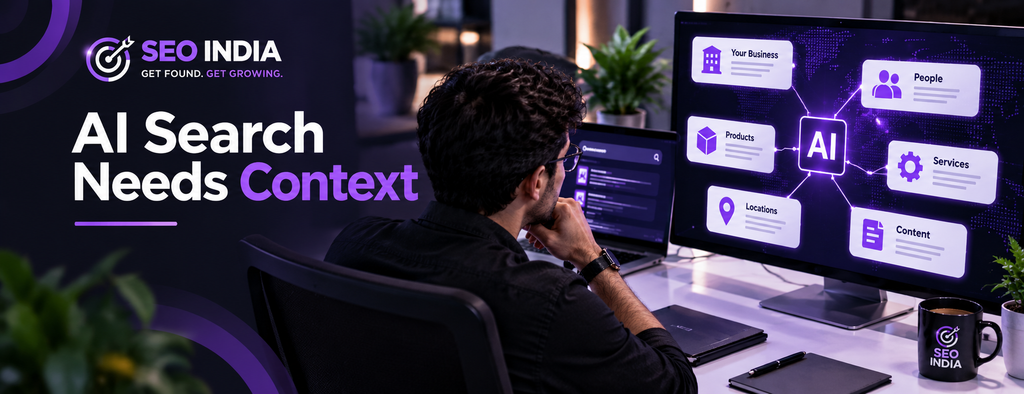
Traditional search gives users choices. AI search gives users conclusions. That difference is exactly why entity SEO has become so important.
When an AI tool answers a question, it doesn’t list every relevant business. It picks a few it feels confident about. That confidence comes from consistency and corroboration. If your business is described the same way on your website, Google Business Profile, social profiles, directories, and third-party articles, the AI treats that information as reliable. If the details conflict, the AI becomes cautious and may leave you out.
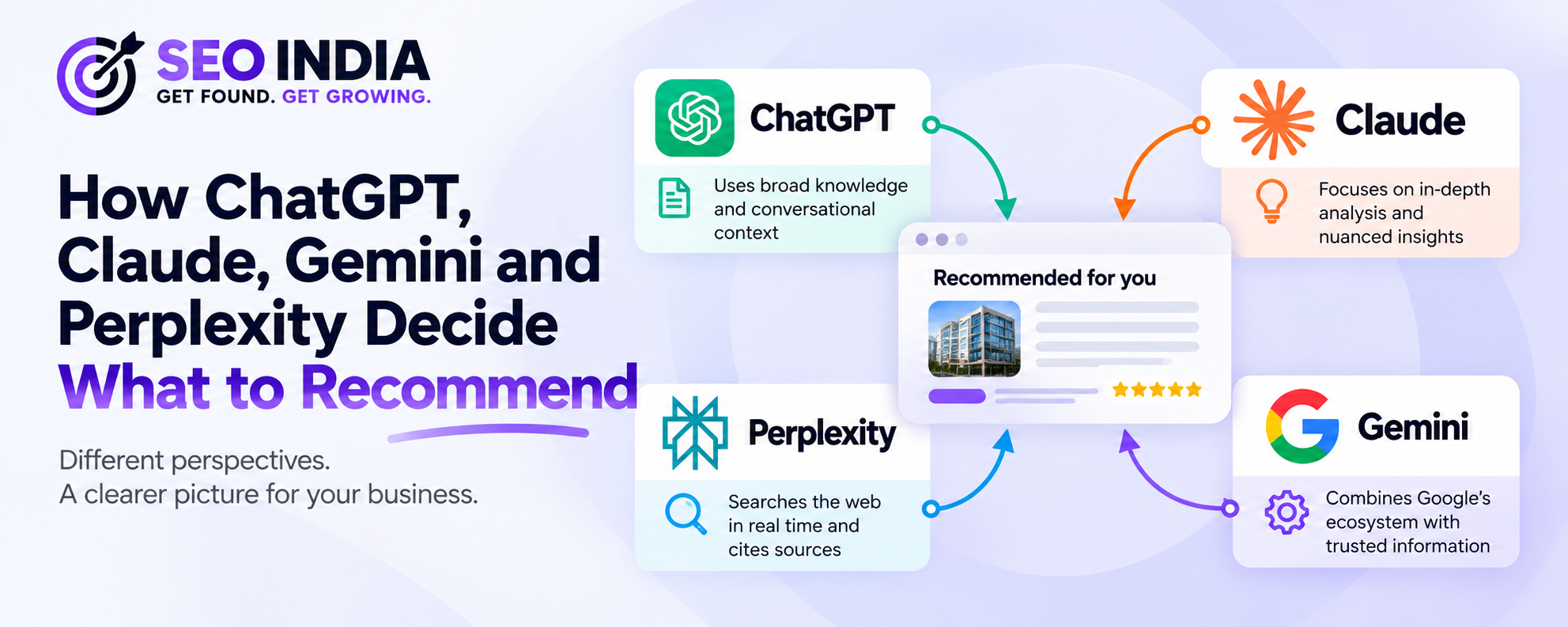
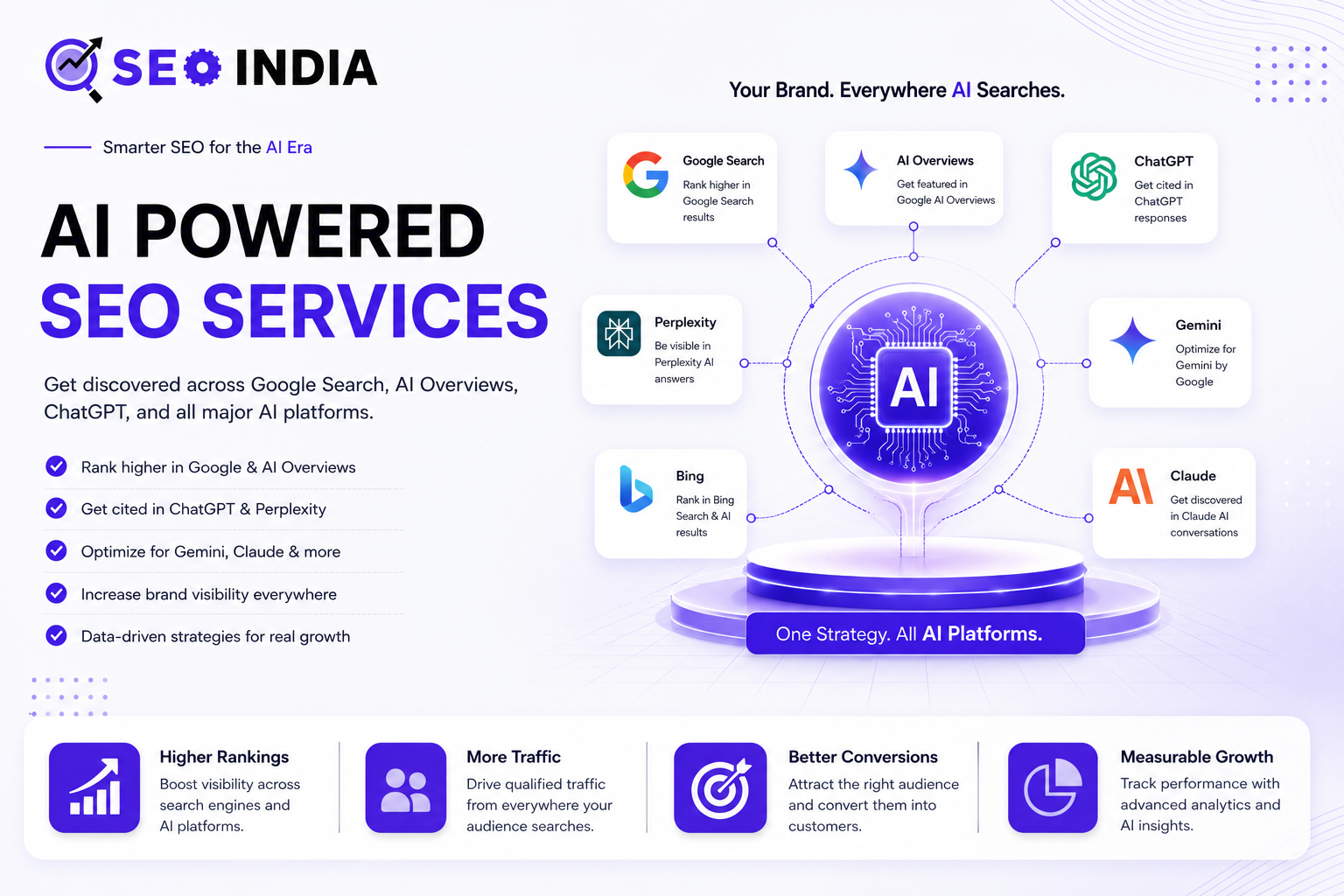
Different AI platforms gather information in different ways. Google’s AI features rely heavily on the Knowledge Graph and structured data. ChatGPT Search combines what the model already knows with fresh web results. Perplexity AI prefers clear, well-organized, citable sources. Google Gemini draws on signals from across Google’s services.
What they share is a preference for businesses that are easy to identify and verify. The stronger your entity, the more often you appear, which is why entity optimization has become the core of LLM SEO.
What Information Makes Up a Business Entity?

Search engines build their understanding of your business by collecting details from many sources and combining them into one profile. The more complete and consistent that profile is, the more trustworthy your entity becomes.
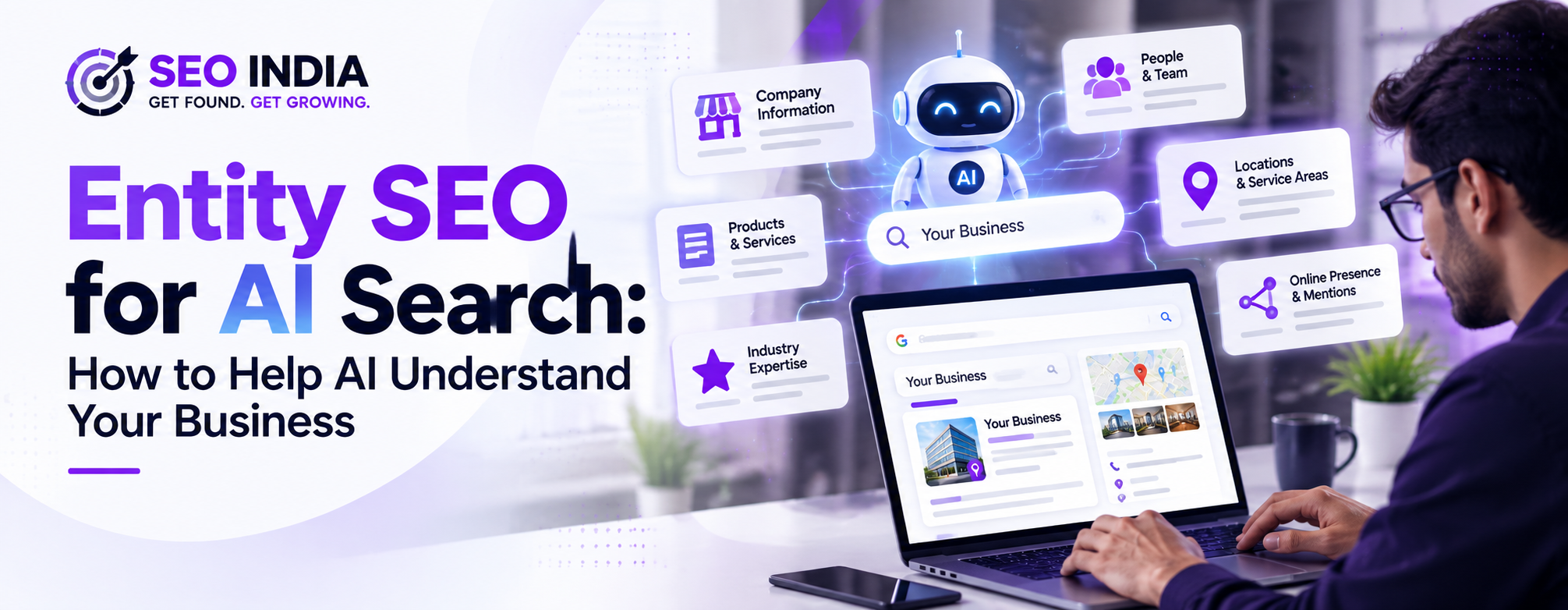
Core identity: your business name, logo, website, founding year, and a clear description of what you do.
Location and contact details: your address, service areas, phone number, email, and Google Business Profile.
Services and focus areas: the specific services you offer and the industries or customer groups you specialize in.
People behind the business: founders, key team members, and content authors, along with their experience and credentials.
Reputation signals: customer reviews, testimonials, case studies, awards, certifications, and press mentions.
Online footprint: social media accounts, business directories, industry associations, partner sites, and articles that reference your brand.
Each of these pieces supports the others. When they all tell the same story, AI systems can describe your business accurately and recommend it with confidence.
Entity Relationships Are More Important Than Isolated Keywords
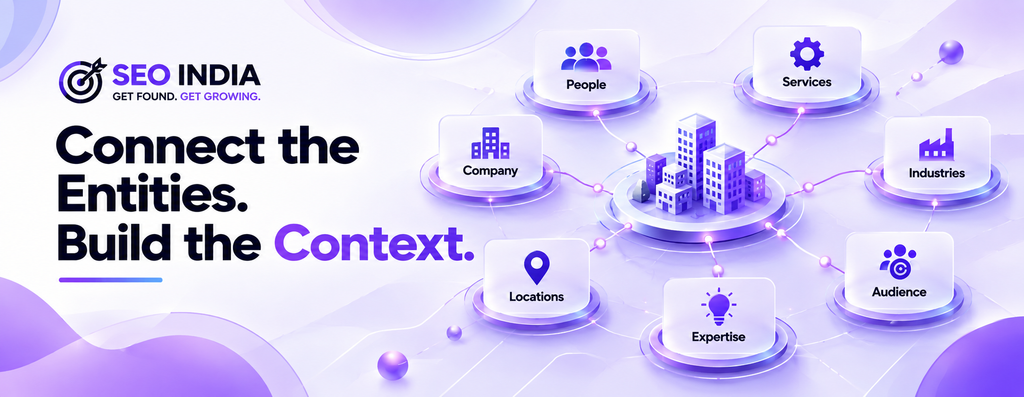
An entity becomes meaningful through the connections it has with other entities. Search engines don’t just ask “what is this business?” They also ask “what is it related to?”
For SEO INDIA, those relationships might include services like AI SEO, local SEO, and PPC advertising; locations like Noida and India; and industries like healthcare, education, franchises, and pest control. Every one of these links gives AI tools another reason to connect SEO INDIA with a relevant question.
A lone keyword can’t create that kind of context. A page ranking for one phrase, with no supporting content and no outside mentions, gives search engines very little to build on.
You can strengthen entity relationships by creating separate pages for each service and industry, such as healthcare SEO, pest control SEO, or education sector SEO. Organize your content into topic clusters, with a central pillar page linked to detailed supporting articles. Use internal links with clear, descriptive anchor text. And earn mentions on websites that are already trusted in your industry, so your brand becomes associated with the right subjects.
The Role of Structured Data and Schema
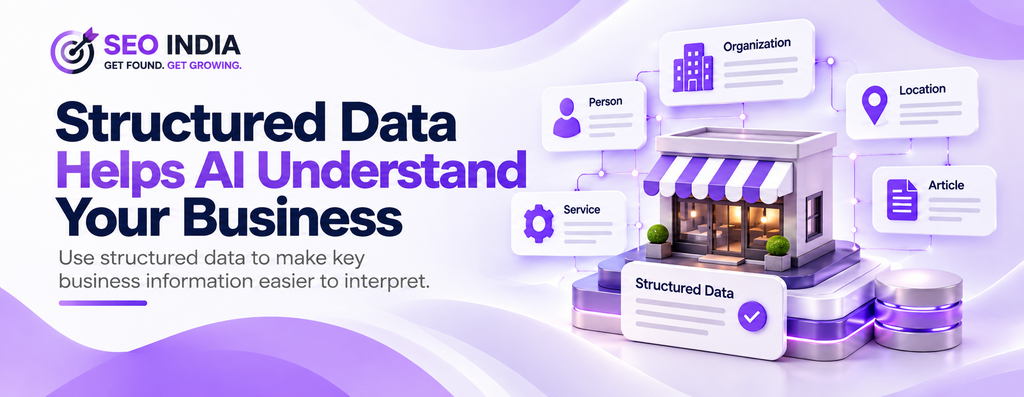
Search engines are good at reading content, but they still have to interpret it. Structured data removes that interpretation step by giving them information in a fixed, machine-readable format.
Schema markup is the most common way to add structured data. For entity SEO, the most helpful types are Organization or LocalBusiness for company details, Service for each offering, Person for founders and authors, Article for blog posts, and FAQPage for question-and-answer content that AI tools can easily reuse.
The sameAs property is especially valuable. It links your website to your official profiles on LinkedIn, Facebook, Instagram, X, and trusted directories, confirming that they all represent the same business. This helps search engines combine scattered information into one clear entity.
To get the most out of schema, keep it accurate, make sure it matches what visitors can see on the page, and update it whenever your business details change. Schema won’t replace good content, but it makes good content far easier for machines to understand.
How to Build a Strong Entity SEO Strategy
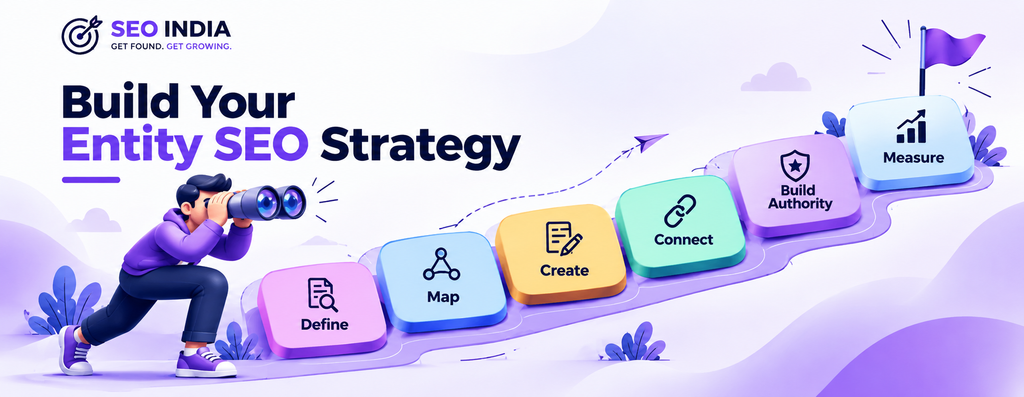
A strong entity SEO strategy is built in layers. Each step makes the next one more effective.
Create a reliable entity home. Choose one page, usually your About page, to act as the official reference for your business. Cover who you are, what you do, where you operate, who leads the company, and what you’ve achieved.
Make your business details consistent. Review every profile and listing where your brand appears. Your name, address, phone number, and description should match everywhere. For businesses serving specific cities, this ties directly into local SEO for business growth.
Add structured data. Implement Organization, Service, Person, and FAQ schema, and connect your official profiles using sameAs.
Build topic clusters. Decide which topics your business should own, then create a pillar page for each and support it with in-depth related content.
Write with clarity. Answer questions directly, explain terms simply, and use headings that accurately describe each section. Our SEO content writing guide covers this approach in detail.
Link your content together. Connect services with industries, blog posts with pillar pages, and related topics with each other so the relationships are easy to follow.
Earn recognition outside your website. Publish guest posts, get featured in industry articles, collect genuine reviews, and secure media coverage. Even unlinked mentions help confirm your entity. This is where off-page SEO strategies play a key role.
Show your expertise. Add author bios, share case studies with real results, and highlight credentials to strengthen E-E-A-T.
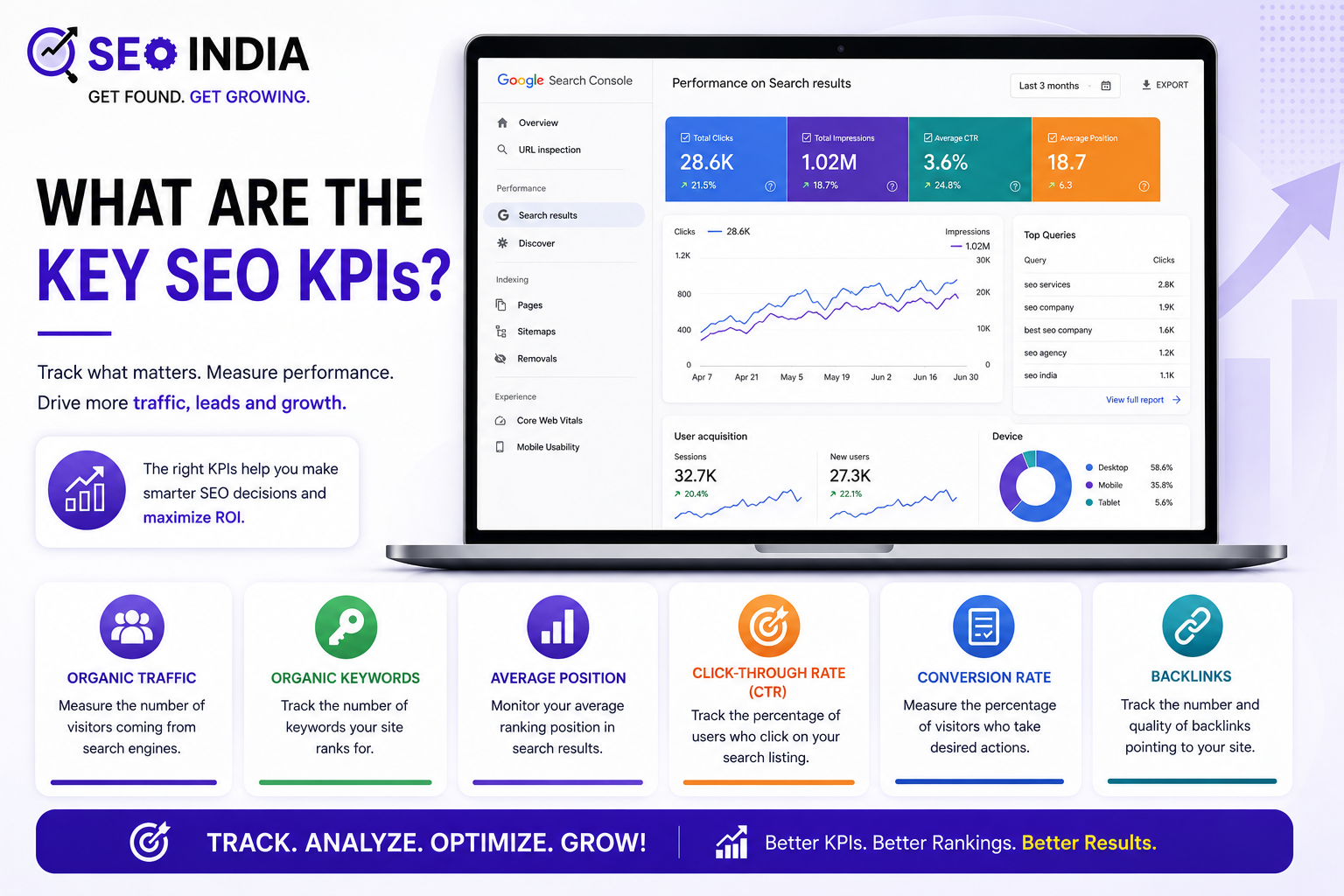
Measure your progress. Track branded search volume, Knowledge Panel visibility, rankings across topic clusters, and how often AI tools mention your business. Our guide to key SEO KPIs can help you choose the right metrics.
Common Entity SEO Mistakes Businesses Should Avoid
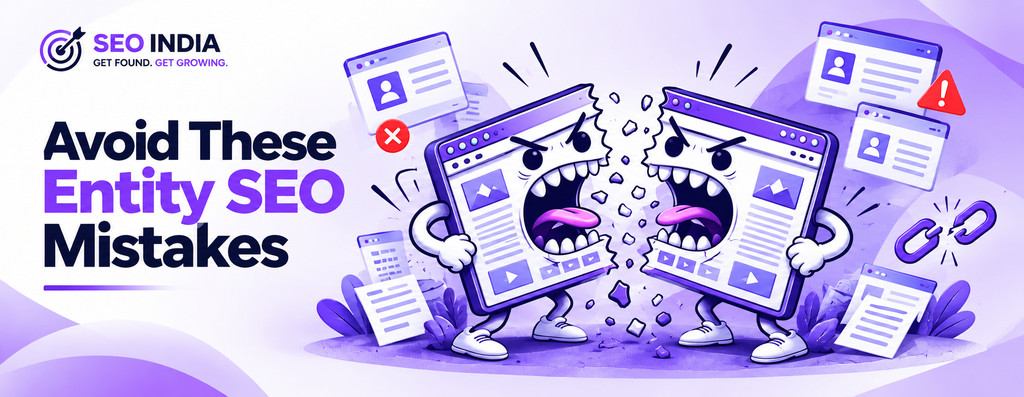
Some of the biggest obstacles to entity SEO are self-inflicted. Watch out for these common errors.
Inconsistent brand names. Small variations across listings can make AI systems think they’re looking at different businesses.
A weak About page. If your About page lacks basic facts, search engines are missing the most important source of information about you.
Incorrect or mismatched schema. Structured data that doesn’t reflect your actual content can reduce trust instead of building it.
Unfocused content. Posting on random topics without clusters or internal links spreads your authority too thin.
Outdated listings. Old addresses, phone numbers, or service descriptions on directories and profiles create confusion.
Shortcuts and manipulation. Keyword stuffing, fake reviews, or artificial mentions aimed at gaming AI answers can seriously damage your credibility, as search engines increasingly treat these tactics as spam.
Correcting these issues is often the fastest way to improve how search engines and AI tools see your business.
How SEO INDIA Can Help With Entity SEO
At SEO INDIA, we help businesses build a clear, trusted identity that search engines and AI platforms can easily understand, from Google Search and AI Overviews to ChatGPT, Gemini, and Perplexity.
Our entity SEO process starts with an audit of how your business currently appears to search engines and AI tools. We then fix inconsistent information across the web, strengthen your entity home, and add schema markup that accurately reflects your services and industries. Our team builds topic clusters to establish authority, creates content that serves both readers and AI systems, and develops credible mentions that reinforce your reputation.
We work with businesses across healthcare, education, manufacturing, logistics, home services, franchises, and more. No matter your industry, our AI-powered SEO services are designed to help AI tools understand your business and recommend it to the right customers.
Want to know how AI currently understands your business? Get your free SEO proposal and let our experts show you what’s working and what needs attention.
Frequently Asked Questions About Entity SEO
What is entity SEO in simple words?
Entity SEO is about helping search engines and AI tools clearly understand your business: what it is, what it does, who it serves, and which topics it’s an expert in.
Why is entity SEO important for AI search?
AI tools recommend businesses they can identify and trust. Entity SEO builds that clarity and trust, which increases your chances of appearing in AI-generated answers.
Is entity SEO different from keyword SEO?
Yes. Keyword SEO focuses on matching pages to search terms, while entity SEO focuses on building a clear identity for your entire brand. Both work best together.
Does schema markup help with entity SEO?
Yes. Schema gives search engines a structured, direct description of your business, making it easier for them to understand and connect your information.
Can local businesses benefit from entity SEO?
Definitely. A consistent, well-defined local business entity helps you appear in local search results and in AI recommendations for nearby customers.
How soon can I expect results?
Technical improvements like schema and consistent listings can be recognized in a few weeks. Stronger authority through content and mentions generally builds over a few months.
Final Takeaway